Problem addressed
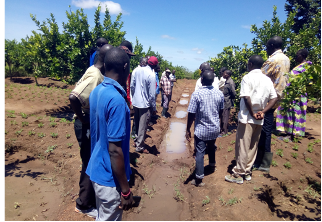
Teso Sub-region of Eastern Uganda was famous for citrus (oranges) production up to the 1990s but the volumes and quality continuously declined thereafter. With climate variability, moisture stress, among others, contributed greatly to the abandonment of citrus production by most farmers. The prolonged drought period of December to February caused a lot of trees to dry up. There was a need to harvest and trap water within citrus orchards in order to maintain moisture within the root zone of citrus trees. Basins and trenches would allow rain water to slowly sip into the soil
About this technology
Preparing effective trenches and basins:
For basin,
• Gently scoop soil from the tree trunk and hip it around tree canopy edge to create depression (basin),
• Scoop the soil to a depth of 15-20 cm, taking care not to destroy roots
For trench,
• Mark the centre of each row between citrus trees
• Construct a trench of 2 ft wide, with 1 ft on each side of the centre line.
• Dig the trench 2 ft deep in young orchards (up to 7 years) and 1.5 ft deep in mature trees (beyond 7 years)
• Combine the trenches and basins by connecting a trench to individual basins
Performance and benefits
Where it is suitable
Application guidance
Preparing effective trenches and basins:
For basin,
• Gently scoop soil from the tree trunk and hip it around tree canopy edge to create depression (basin),
• Scoop the soil to a depth of 15-20 cm, taking care not to destroy roots
For trench,
• Mark the centre of each row between citrus trees
• Construct a trench of 2 ft wide, with 1 ft on each side of the centre line.
• Dig the trench 2 ft deep in young orchards (up to 7 years) and 1.5 ft deep in mature trees (beyond 7 years)
• Combine the trenches and basins by connecting a trench to individual basins